

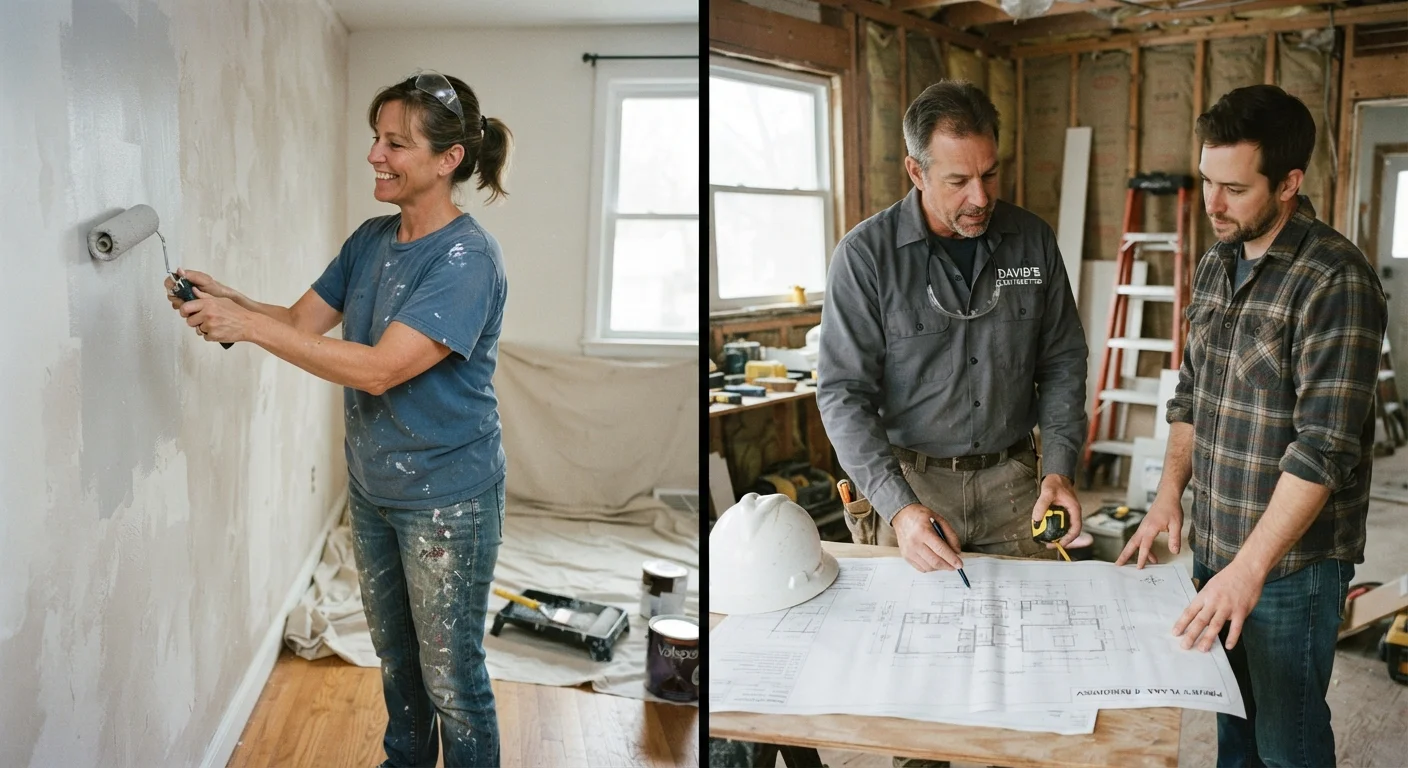
Key Takeaways
Eliminates labor costs on straightforward jobs
Labor often represents 40 to 60 percent of a contractor's total invoice for common repairs. On simple tasks like painting, caulking, or minor patching, doing the work yourself keeps that portion in your pocket.
Builds practical skills for future repairs
Successfully completing a small project gives you working knowledge that applies to similar jobs later. A homeowner who learns to patch drywall correctly can handle that task independently going forward.
You control the pace and materials
DIY lets you choose material quality without a contractor's markup, and you can spread the work across weekends to fit your budget and schedule.
Low-stakes cosmetic work has a forgiving margin
Painting, staining a deck, or replacing cabinet hardware involves mistakes that are visible and correctable before they become structural or safety problems.
Errors on regulated work create legal and financial exposure
Unpermitted electrical, plumbing, or structural work can complicate a home sale and may void portions of your homeowners insurance coverage if a related claim arises.
Time cost is easy to underestimate
A job that takes a professional half a day can take an inexperienced homeowner an entire weekend, plus additional time for supply runs, tutorials, and corrections.
Mistakes on complex jobs compound in cost
A plumbing leak inside a wall, a wiring error, or an improperly supported structural modification can produce repair bills that significantly exceed what a licensed contractor would have charged for the original job.
Specialized tools add hidden expense
Some repairs require tools you do not own and may not need again. Purchasing or renting them can narrow or eliminate the cost advantage over hiring a professional.
Safety risks on hazardous systems are serious
Work involving electrical panels, gas lines, or load-bearing structures carries injury and fire risks that go beyond financial consequences. These jobs exist in a different risk category from cosmetic repairs.
Our Verdict
DIY repairs make financial sense for cosmetic, low-risk tasks where a mistake is correctable and the skill ceiling is low. For work that touches safety systems, structural integrity, or local code compliance, hiring a licensed professional is almost always the more cost-effective path when you account for the full cost of getting it wrong.
Families who want to stretch their home improvement budget without taking on hidden financial or safety risks.
Where the DIY calculation actually works
The appeal of doing it yourself is straightforward: you pay for materials, not labor. On jobs where labor accounts for the majority of a contractor's invoice, that gap can be meaningful. Painting interior walls, replacing light switch covers, patching small drywall holes, recaulking a bathtub, or installing a new showerhead are jobs where the materials are inexpensive, the steps are well-documented, and a mistake is usually fixable before it becomes a bigger problem.
The calculation shifts once you factor in your own time honestly. A weekend project that a professional crew finishes in four hours can stretch to two full weekends if you are learning as you go, waiting for a second coat to dry, or making a return trip to the hardware store for the right tool. That time has value, even if it does not show up on an invoice.
For cosmetic work with a low skill ceiling, DIY is a reasonable choice for most families. See our guide to paint prep mistakes before you start, because surface preparation is where most DIY paint jobs fail.
Eliminates labor costs on straightforward jobs
Labor often represents 40 to 60 percent of a contractor's total invoice for common repairs. On simple tasks like painting, caulking, or minor patching, doing the work yourself keeps that portion in your pocket.
Builds practical skills for future repairs
Successfully completing a small project gives you working knowledge that applies to similar jobs later. A homeowner who learns to patch drywall correctly can handle that task independently going forward.
You control the pace and materials
DIY lets you choose material quality without a contractor's markup, and you can spread the work across weekends to fit your budget and schedule.
Low-stakes cosmetic work has a forgiving margin
Painting, staining a deck, or replacing cabinet hardware involves mistakes that are visible and correctable before they become structural or safety problems.
Jobs that carry real risk when handled incorrectly
Certain categories of home repair are regulated because the consequences of errors extend beyond the homeowner. Electrical panel work, running new circuits, gas line connections, load-bearing wall modifications, roof replacement, and any plumbing that ties into the main supply or drain stack all fall into this category in most US jurisdictions.
Local building codes in most states require licensed contractors and permits for these jobs. Unpermitted work does not just risk a fine; it can create problems when you sell the property, since a home inspection will often flag work that was done without a permit. Some homeowners insurance policies also exclude claims arising from unpermitted or improperly executed repairs.
The rule of thumb is simple: if the repair involves a system that could injure someone, damage the structure, or violate a local code, get a licensed professional. Contact your local building department to confirm what requires a permit in your area before you start any significant project.
Errors on regulated work create legal and financial exposure
Unpermitted electrical, plumbing, or structural work can complicate a home sale and may void portions of your homeowners insurance coverage if a related claim arises.
Time cost is easy to underestimate
A job that takes a professional half a day can take an inexperienced homeowner an entire weekend, plus additional time for supply runs, tutorials, and corrections.
Mistakes on complex jobs compound in cost
A plumbing leak inside a wall, a wiring error, or an improperly supported structural modification can produce repair bills that significantly exceed what a licensed contractor would have charged for the original job.
Specialized tools add hidden expense
Some repairs require tools you do not own and may not need again. Purchasing or renting them can narrow or eliminate the cost advantage over hiring a professional.
Safety risks on hazardous systems are serious
Work involving electrical panels, gas lines, or load-bearing structures carries injury and fire risks that go beyond financial consequences. These jobs exist in a different risk category from cosmetic repairs.
How to evaluate contractor quotes fairly
When you decide to hire out, the price difference between two quotes for the same job can be significant. Labor rates, materials sourcing, and overhead all vary by contractor. Getting at least two written quotes gives you a baseline and lets you ask specific questions about what each quote includes.
Ask whether the quote covers permits, debris removal, and final inspection. A lower number that excludes permits or uses lower-grade materials is not always the better deal. For context on how professional quotes are structured, the same principles that apply to mechanic quotes apply to contractor estimates as well.
40-60%
Typical labor share of a contractor's invoice
Labor commonly represents between 40 and 60 percent of the total cost on standard home repair jobs, which is the primary saving DIY aims to capture.
1 in 3
DIY projects requiring professional correction
A survey by HomeAdvisor found that roughly one in three homeowners who attempted a DIY repair later hired a professional to fix or complete the same job.
When evaluating contractors, verify their license status through your state's licensing board website and confirm they carry general liability insurance and workers' compensation coverage. Ask for references from jobs similar to yours, not just general testimonials.
The cost of getting it wrong
The framing of DIY vs. contractor usually focuses on upfront cost. The more useful question is: what does the repair cost if something goes wrong?
A DIY plumbing mistake that causes a slow leak inside a wall can result in mold remediation costs that far exceed what a plumber would have charged. A wiring error can create a fire hazard. A structural modification done without proper support can compromise a floor or ceiling. These are not hypothetical worst cases; they are the types of problems that show up in home inspections and insurance claims every year.
Smaller mistakes are cheaper but still instructive. A poorly applied tile job, an uneven floor installation, or a paint finish that peels early because the surface was not properly primed all require rework that costs time and materials on top of the original spend. Surface prep failures are one of the most common ways DIY paint projects end up costing more than a professional job would have.
Check permit requirements before you start
Permit requirements vary by state, county, and even municipality. What needs a permit in one city may not in a neighboring town. Your local building department is the authoritative source, and many now list requirements on their websites. Pulling a permit yourself as a homeowner is possible in many jurisdictions for work you do on your own primary residence, but the rules differ. Confirm before you begin, not after.