

Key Takeaways
Repair cost factors
Repair cost factors are the variables that cause the price of the same automotive job to differ from one shop to another. They include labor rates, parts choices, shop overhead, and diagnostic fees. Understanding them helps you compare estimates on equal terms rather than assuming the lowest number is always the right choice.
Labor time is typically estimated using a flat-rate guide (such as Chilton or Mitchell1), which assigns a standard number of hours to each procedure regardless of actual time spent.
How labor rates are set
Labor is almost always the largest line item on a repair bill. Shops set their hourly rate based on local market wages, technician certification levels, and the cost of running the facility. A shop in a high-cost metro area with ASE Master Certified technicians will charge more per hour than an independent shop in a rural market. Rates across the US commonly range from roughly $75 to over $175 per hour, though those figures shift with location and shop type.
What you pay for is not raw clock time. Most shops bill using a flat-rate guide, which assigns a standard number of hours to each procedure. If the guide says a water pump replacement takes 2.5 hours, you are billed for 2.5 hours whether the job takes 90 minutes or four hours. This system rewards experienced technicians and is why two shops with the same hourly rate can still bill different totals if they reference different guides or apply the hours differently to your specific vehicle.
Ask for the flat-rate hours before you agree
When getting an estimate, ask how many flat-rate hours are being billed and which guide the shop uses. This lets you cross-check the same job at another shop on identical terms. A shop that cannot or will not explain its labor hours is a reasonable reason to keep shopping.
Where parts come from and what that does to the price
Parts sourcing is the second major variable. Three tiers exist: original equipment manufacturer (OEM) parts made by or for your vehicle's maker, aftermarket parts produced by independent suppliers, and used or remanufactured parts from salvage yards or rebuilders.
OEM parts carry the manufacturer's specifications and often come with a warranty, but they cost more. Aftermarket parts range from budget-grade to premium lines that meet or exceed OEM specs. A shop's preference or supplier relationship shapes which tier appears on your estimate by default. Asking specifically which parts will be used, and whether alternatives are available, is a reasonable question before authorizing any work.
For more on when to handle a job yourself versus trusting a shop's parts selection, see DIY vs. mechanic guidance on which jobs to hand off.
$75-$175+
Typical US shop labor rate range per hour
Labor rates vary by region, shop type, and technician certification; metropolitan areas consistently sit at the higher end of this range.
20-40%
Typical dealer-vs-independent price gap
For equivalent work, dealerships commonly quote 20 to 40 percent more than independent shops, largely due to higher facility overhead and OEM parts pricing.
3
Estimates worth gathering before authorizing major repairs
Consumer advocates and automotive educators broadly recommend collecting at least two to three written estimates for any repair above a few hundred dollars.
Overhead, shop type, and what you are paying for beyond the repair
Every shop bundles its overhead into labor rates and supply charges. Dealerships carry higher costs for facilities, manufacturer training, and specialized diagnostic equipment. Those costs appear in your bill. Independent shops generally run leaner and can pass some of that difference to the customer, though this varies by shop.
Specialty shops (transmission shops, exhaust specialists) often carry dedicated tooling and focused experience that can make them more efficient on specific jobs despite competitive rates. Quick-service chains trade speed and convenience for a narrower scope of work, which limits them to simpler jobs where per-unit cost is managed through volume.
Understanding that overhead is already priced in helps explain why the same job at a dealership and at an independent shop can differ by 20 to 40 percent, even with identical parts. If delaying a repair to save money is part of your thinking, why small repairs grow into bigger bills walks through how that math usually plays out.
How to read and compare estimates
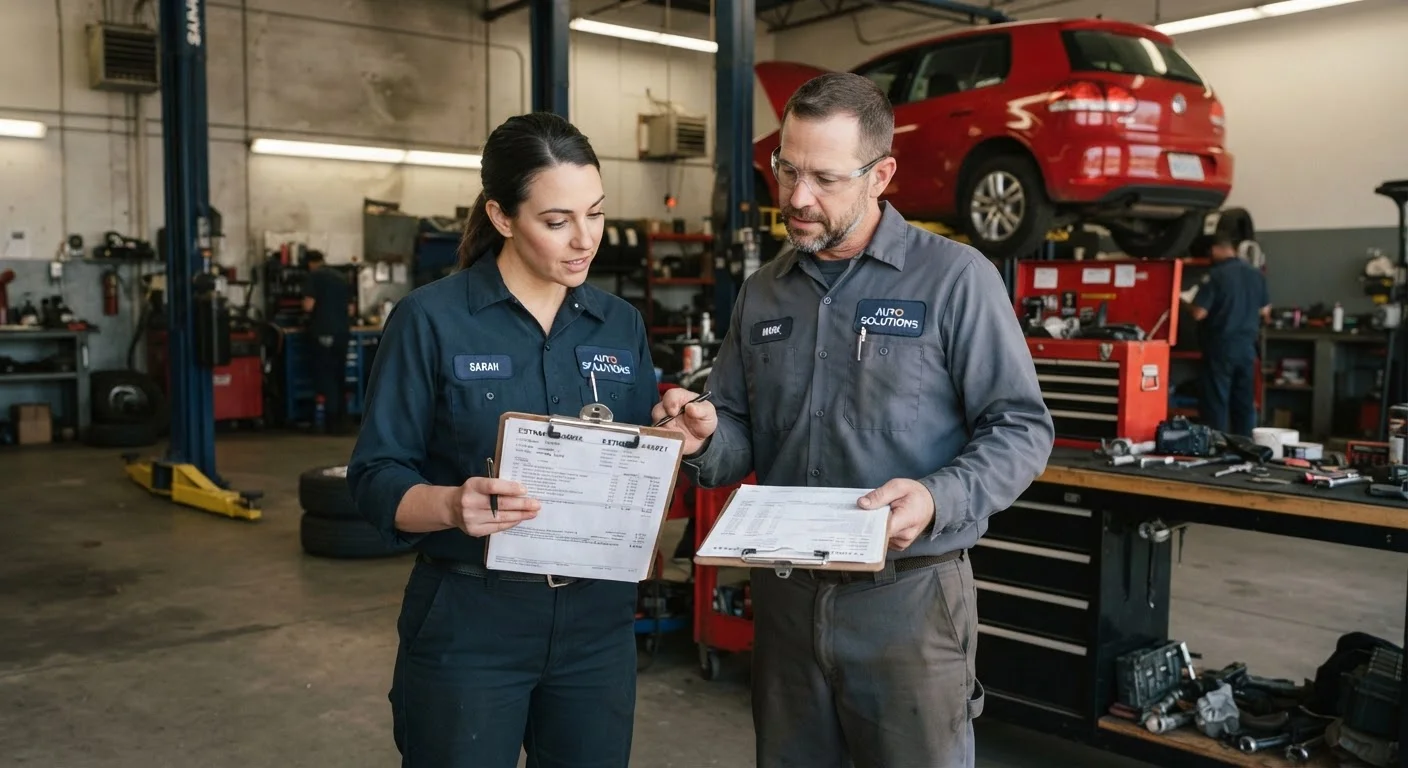
A written estimate should itemize labor hours and rate, each part with its price, and any additional fees such as shop supplies or disposal charges. When two estimates look very different, the first step is to confirm the scope is identical. One shop may have included a related inspection or a fluid flush that the other skipped.
Check whether each estimate specifies OEM, aftermarket, or remanufactured parts. A lower total built on unknown-grade parts is not necessarily a bargain. Ask about the labor and parts warranty at each shop; many reputable independents offer 12-month or 12,000-mile warranties comparable to dealership terms.
The same analytical habit applies when comparing costs in other areas of household budgeting. The principles behind evaluating a repair estimate share DNA with decisions like weighing the real costs of renting versus buying: visible price is rarely the whole picture.
A family in a suburban Chicago neighborhood gets a brake job quote of $420 from a dealership and $265 from a nearby independent shop.
Two independent shops quote a timing belt replacement at $550 and $710 for the same vehicle.
A driver in rural Texas receives a $180 estimate for a coolant flush that a dealership in Austin quoted at $290.