

Key Takeaways
Start here
Why tire pressure matters more than most families realize
Next
How to check and set tire pressure correctly
Then
Tread depth: the number your family's safety depends on
Finally
Other tire basics families often skip
Why tire pressure matters more than most families realize
Tires are the only part of a vehicle that contacts the road, yet most families never think about them until something goes wrong. Underinflation is the most common and most costly tire problem. The US Department of Energy has found that properly inflated tires can improve fuel economy by up to 3 percent. On a vehicle averaging 20 mpg and driving 15,000 miles per year, that translates to real money over time.
Beyond fuel, underinflated tires wear faster and unevenly, shortening the life of a set that might otherwise last 50,000 or more miles. Overinflation is also a problem: a tire pumped too hard has less contact area with the road, which reduces grip and makes the ride harsher.
Temperature change affects pressure more than most drivers expect. Tires lose roughly 1 PSI (pound per square inch) for every 10-degree Fahrenheit drop in ambient temperature. A tire at the correct pressure on a 70-degree day can be 4 to 5 PSI low on a cold winter morning, with no visible sign that anything is wrong.
Check pressure monthly, not just at the pump
Gas station air pumps with built-in gauges are often poorly calibrated. A dedicated handheld gauge gives a more reliable reading. Get in the habit of checking all four tires once a month, on the same day you get your monthly bank statement or phone bill, so it becomes routine.
How to check and set tire pressure correctly
The correct target pressure for your vehicle is printed on a sticker inside the driver's door jamb. It is not the number molded into the tire sidewall; that figure is the maximum the tire can safely hold, which is almost always higher than the vehicle manufacturer's recommendation.
Check pressure when the tires are cold, meaning the car has been parked for at least three hours or driven fewer than a mile. Driving heats the air inside the tire and raises the reading, making a warm tire appear correctly inflated when it is actually low.
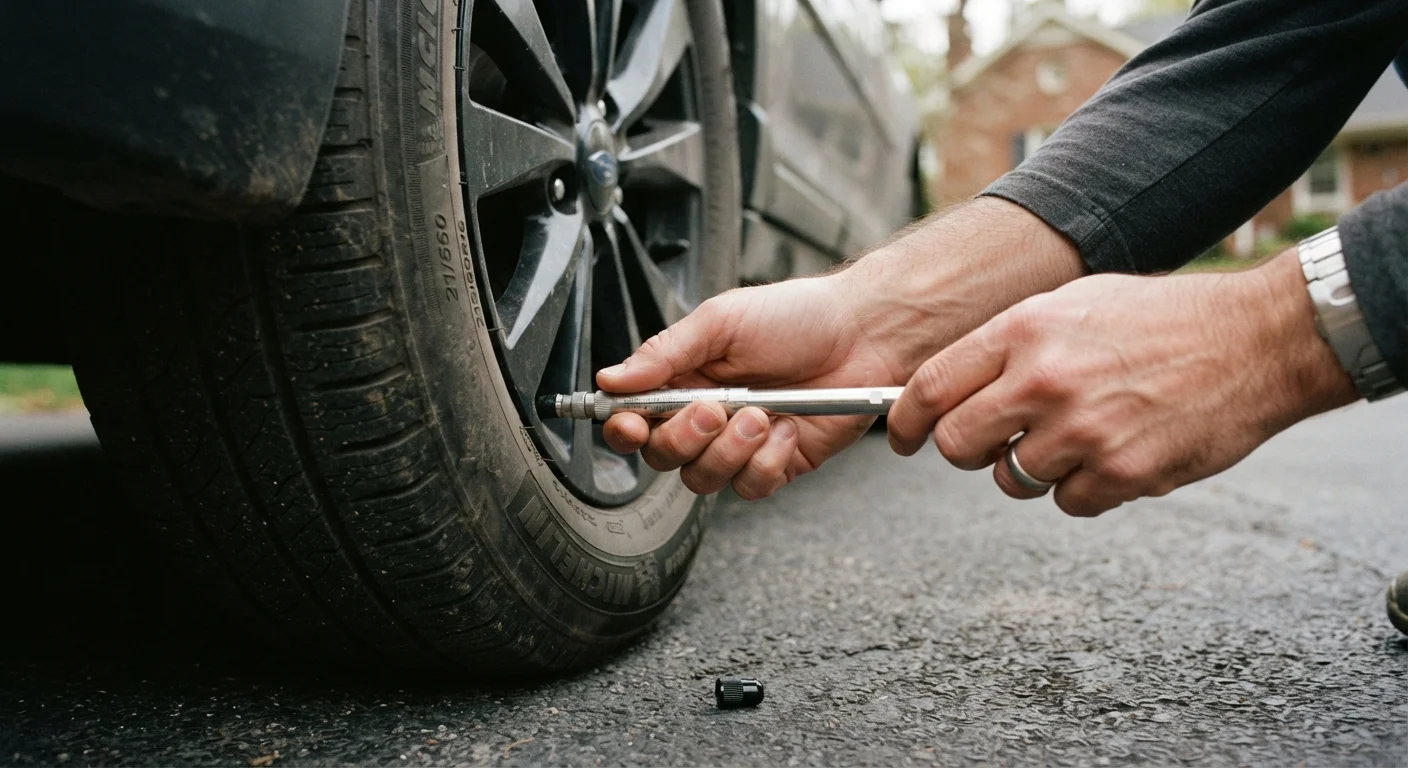
- Remove the valve cap from the tire stem and set it somewhere you will not lose it.
- Press the gauge firmly and squarely onto the valve stem until the hissing stops.
- Read the PSI on the gauge display or stick scale.
- Add air at a gas station compressor or home inflator until you reach the door-sticker figure.
- If you overshoot, press the small pin in the center of the valve stem to release air in short bursts.
- Replace the valve cap.
A quality digital gauge costs less than $15 at most auto parts stores. Analog stick gauges work fine too and have no batteries to fail.
For context on how tire care fits into broader seasonal maintenance, see what to check before every school year.
Tread depth: the number your family's safety depends on
Tread depth is measured in 32nds of an inch. New all-season tires typically start at 10/32 or 11/32. Most US states require tires to be replaced at 2/32, at which point a Lincoln penny inserted upside-down into the tread groove will show Lincoln's entire head. However, stopping distances on wet pavement increase substantially before tires reach that legal minimum.
A more conservative and widely recommended threshold is 4/32. At that depth, a quarter inserted the same way will show the top of Washington's head. This extra margin matters most in rain and light snow.
PSI
Pounds per square inch, the unit used to measure air pressure inside a tire. Your vehicle's recommended PSI is listed on the driver's door jamb sticker.
Tread depth
The measurement from the top of the rubber tread to the bottom of the groove. It tells you how much gripping surface remains and when a tire needs replacing.
Tread wear indicator
A small raised bar molded into the tread grooves at the 2/32-inch level. When the tread wears flush with the bar, the tire has reached its legal minimum in most US states.
Valve stem
The short metal or rubber tube protruding from the wheel where you attach a gauge or air hose. The valve cap screws onto the top to protect it.
Tire rotation
Moving each tire to a different position on the vehicle at regular intervals so that wear is distributed evenly across all four tires.
Cold inflation pressure
The tire pressure measured after the car has sat for at least three hours, before heat from driving has expanded the air inside. This is the condition in which pressure should always be checked and set.
A basic tread depth gauge, available for a few dollars, gives an exact reading. Tread wear indicator bars are molded into the grooves of most modern tires and become flush with the surface at 2/32, giving a visual cue that the tire has reached its legal limit.
Uneven wear is also worth monitoring. Wear concentrated in the center of the tread suggests chronic overinflation. Wear on both outer edges points to chronic underinflation. Wear on one edge often points to a wheel alignment issue. Catching these patterns early can prevent a $100 alignment from becoming a $600 tire replacement.
If your tires are approaching replacement, understanding the tradeoffs between new tires and retreads can help you make an informed decision.
Other tire basics families often skip
Rotation and spare tire checks are the two maintenance steps families most consistently skip.
Rotating tires every 5,000 to 8,000 miles, or at every other oil change, evens out wear across all four positions. Front tires on front-wheel-drive vehicles do the work of steering and much of the braking, so they wear significantly faster than rear tires without rotation. A rotation typically costs $20 to $50 at a shop, though many tire retailers include it free with purchase.
Spare tires, whether a full-size spare or a compact temporary spare (often called a donut), can lose pressure while sitting in the trunk untouched. Check the spare every few months. A compact spare is rated for limited speeds and distances, typically no more than 50 mph and 50 to 70 miles, so it is not a substitute for a proper repair or replacement. Confirm the specific ratings in your owner's manual.
Valve stem caps may seem trivial, but they keep dirt and moisture out of the valve core, which can cause a slow, hard-to-diagnose leak. Replacing a missing cap takes seconds and costs almost nothing.
Proper tire habits also compound with other maintenance. Keeping a high-mileage family car on the road longer covers how tire care fits alongside other strategies for extending vehicle life. And if you are planning a long drive, road trip planning for families on a tight budget includes tire prep as part of pre-trip readiness.